
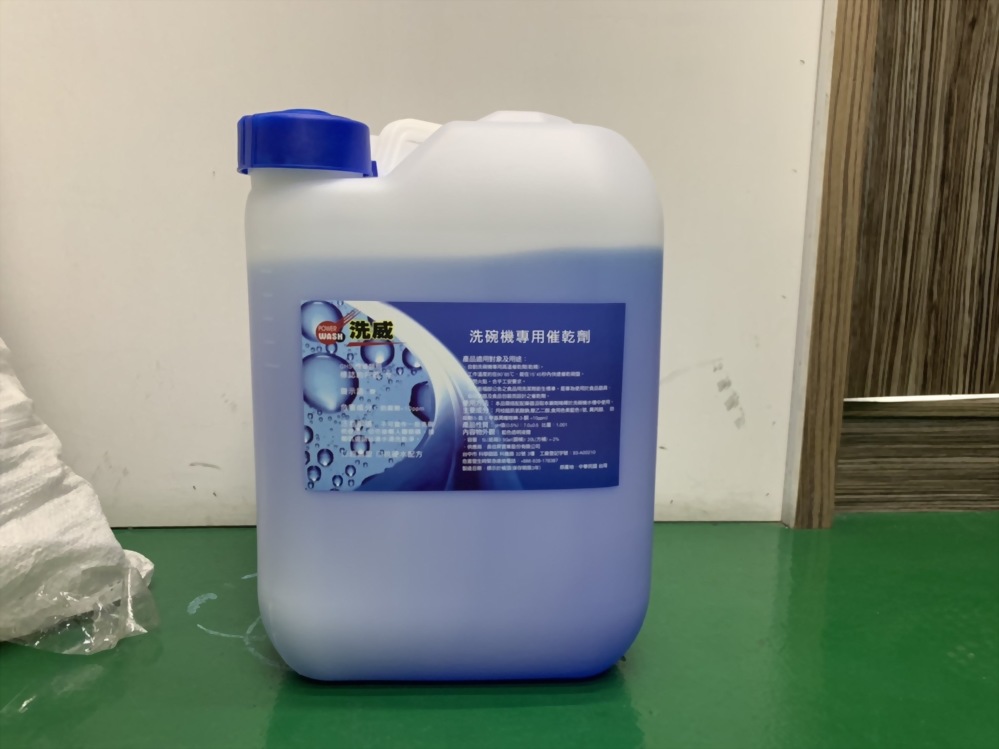
Information about PowerWash™ Pure and clean drying agent B6A3N2
EverDependUp Co., Ltd.
DESCRIPTION
USES
Consult your Service Representative for specific directions.
Use only in an approved dispenser.
SAFETY DATA SHEET
1. IDENTIFICATION OF THE SUBSTANCE/PREPARATION AND OF THE COMPANY UNDERTAKING
Trade name: PowerWash™ Pure and clean drying agent B6A3N2
Producer: EverDependUp Co., Ltd.
Address: 3F., No.32, Keya Rd., Daya Dist., Taichung City 428, Taiwan (R.O.C.)
TEL: +886-4-25600139
FAX: +886-4-25600149
Emergency phone: +886-928-178387
2. HAZARDS IDENTIFICATION
GHS Symbol: None
Hazard statement:
Do not use as a general dishwashing detergent.
Do not contact with eyes.
In case of contact with skin, wash with clean water.
Prolonged contact may lead to irritation.
3. COMPOSITION/INFORMATION ON INGREDIENTS
| Substance name | CAS No. | Amount (%W/W) |
|---|---|---|
| Sodium lauroyl sarcosinate | 137-16-6 | 0.1~4.9% |
| Citric Acid | 77-92-9 | 1~11% |
| Polyethylene glycol | 25322-68-3 | 1~11% |
| Brilliant blue FCF | 4712-70-3 | 0.001~0.1% |
| Isopropyl alcohol | 67-63-0 | 0.1~10% |
| 5-Chloro-2-methyl-4-isothiazolin-3-one | 26172-55-4 | <0.001% |
| Water | 7732-18-5 | Balance to 100% |
3.1 HAZARDS IDENTIFICATION
- Prolonged contact may lead to irritation.
4. FIRST AID MEASURES
4.1 Eye contact:
- Rinse immediately with plenty of water for 15 minutes.
- If irritation persists consult a doctor/medical service.
4.2 Skin contact:
- Wash immediately with lots of water and soap for 15 minutes.
- Remove clothing while washing.
- Do not remove clothing if it sticks to the skin.
- If irritation persists consult a doctor/medical service.
4.3 After inhalation:
- Remove the victim into fresh air.
- Unconscious: maintain adequate airway and respiration.
- If breathing problems develop: consult a doctor/medical service.
4.4 After ingestion:
- Immediately after ingestion: give lots of water to drink.
- Never give water to an unconscious person.
- Allow vomiting but avoid choking.
- If you feel unwell: consult a doctor/medical service.
5. FIRE FIGHTING MEASURES
5.1 Suitable extinguishing media:
-Water spray
-Polyvalent foam
-Alcohol foam
-BC powder
-Carbon dioxide
5.2 Special protective equipment for firefighters:
- Heat/fire exposure: compressed air/oxygen apparatus of gas-tight suit.
6. ACCIDENTAL RELEASE MEASURES
Personal Protection:
Respiratory: Gauze mask.
Eye: Approved safety glasses with side shield.
Clothes: Protective work clothes.
Additional Comments:
Eye washes and safety showers should be available.
Educate and train employees in the use of this product, besides also follow all label instructions.
Environmental Precaution:
Should not be allowed to enter drain or watercourses.
Methods for cleaning up:
Contain spill with inert material.
Absorb in vermiculite, dry sand or earth.
Place in the container for disposal according to local regulation.
7. HANDLING AND STORAGE
Handling:
Mechanical ventilation or local exhaust ventilation is required.
Avoid all unnecessary.
Storage Conditions:
Keep contains tightly closed.
Keep away from heat.
8. EXPOSURE CONTROLS/PERSONAL PROTECTION
Exposure Limit Comments: None established.
Engineering controls:
Mechanical ventilation or local exhaust ventilation is required.
Hand: Use protective gloves made of Butyl rubber.
Wear tightly fitting safety goggles and full-face visor or shield.
Skin and body: Use suitable protective clothing as protection against splashing or contamination.
Launder cloths before re-use.
9. PHYSICAL AND CHEMICAL PROPERTIES
Appearance: Blue liquid
Odor: mild.
Non-Flammable (aqueous solution)
Specific Gravity (H2O is: 1): 1.000~1.012
pH value (1%): 6.5+-1.0
Flash point: ND. (closed/open cup)
Boiling point: >100 °C
Ignite Temp.: ND.
Solubility: Miscible with water.
Vapor pressure: N.A.
Evaporation Rate (BuAc = 1.0): N.A.
10. STABILITY AND REACTIVITY
Thermal decomposition: No thermal decomposition when stored and handled correctly.
11. TOXICOLOGICAL INFORMATION
Acute toxicity: LD50 > 5000 mg/kg (rat ingestion).
Inhalation: May cause damage to lungs.
Skin contact: slight skin irritation.
Eye contact: Slight eye irritation, but does not cause permanent damage.
Urgency and Chronic Toxicity: This material is less toxic and causes only mild irritation to the human body.
No reports of exposure have so far been reported.
No reports so far indicate carcinogenicity to humans or experimental animals.
Irritation: May cause slight irritation to the skin and eyes.
Carcinogenicity: No information available at this moment shows carcinogenicity.
12. ECOLOGICAL INFORMATION
Environmental Fate:
When released into the soil, this material is not expected to evaporate significantly.
When released into the soil, this material may leach into groundwater.
When released into the soil, this material may biodegrade to a moderate extent.
When released into water, this material is not expected to evaporate significantly.
When released into water, this material may biodegrade to a moderate extent.
This material has an estimated bioconcentration factor (BCF) of less than 100.
This material is not expected to significantly bioaccumulate.
When released into the air, this material is expected to be readily degraded by reaction with photochemically produced hydroxyl radicals.
When released into the air, this material is expected to have a half-life of less than 1 day.
The biological decomposition degree of the product, by reference to the nature of raw materials, it is estimated that the biological decomposition degree > 90%.
Environmental Toxicity:
The LC50/96-hour values for fish are over 100 mg/l.
This material is not expected to be toxic to aquatic life.
13. DISPOSAL CONSIDERATIONS
Disposal methods:
Dispose in safe map in accordance with local/national regulations.
Completely empty contents of drums before discarding.
Waste category:
Disposal of in accordance with local authority requirements.
14. TRANSPORT INFORMATION
Transportation regulation varies by local.
Dangerous Goods Code:
UN Number: Not regulated
Packing flag: Not specified
Packing Group:
Packing method:
Transportation Note:
15. REGULATION INFORMATION
Labor Safety and Health Rules.
Dangerous and Harmful Material of general rules.
Labor operating environment allowable concentration of harmful substances in the air standard.
Road traffic safety rules.
Industrial Waste Storage and Disposal and Facility Standards.
Public dangerous goods and flammable pressurized gases Establishment Standards and Safety Management Measures.
International regulations.
16. OTHER INFORMATION
References: Labor Safety and Health Council of Labor Affairs Department hazardous materials and hazardous material labeling and Liberal rule.
Safety and Health Technology Center Taiwan 2008 GHS Implementation Update.
EPA toxic chemicals labeling and material safety data sheet management approach.
Watchmaking unit: a long letter Sheng Industrial Co., Ltd. R & D
Phone: +886 4 25600139
Tabulation Date: 2025/06/19 | Lister: Chen, Ying-Chi
The information only concerns the above mentioned product as supplied and may not be valid if used with other products or in any process.
It remains the user’s own responsibility to make sure that the information is appreciate and complete for the special use of this product.