
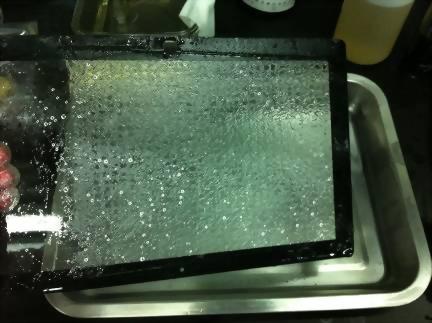
According to the test results, NGC02 has the best clearing effect


Ps.The attached picture shows the result after a few minutes of infiltration, and the whole piece can be pulled off by Peel
NGC02 applied to stripping 3M OCA optical glue test report (customer self-test)
According to the test results, NGC02 has the best clearing effect
Ps.The attached picture shows the result after a few minutes of infiltration, and the whole piece can be pulled off by Peel
NGC02, SynGC04, SynGC05, SynGC06 and SynGC09 are applied to CG samples, and the OCA optical sheet glue (3M 8146) is removed from the test report
Before soaking.


Place in NGC02 and soak for 1 hour at room temperature. (Supplement: Soak NGC02 at room temperature for 24 hours, the effect will not be better.)


Take it out and find that the OCA sheet glue has swelled and lost its viscosity. Scrape off residual glue with a plastic scraper.

The plastic scraper can scrape off the swollen and softened glue. After scraping, wash it with water and dry it. Under light irradiation, it was found that there was still a thin layer of residual glue close to the glass that could not be removed. Use a dust-free cloth to wipe with the micro-dust cleaner PTC05. After washing with water, the thinner glue can be removed. The right side of the CG film in the figure below is the result of soaking NGC02 for 1 hour → washing with water, drying → wiping with PTC05. The left side of the CG film in the figure below is the result of soaking NGC02 for 1 hour→cleaning with water and drying→wiping with NGC02→wiping with PTC05. After the glue is found, wipe it once with a dust-free cloth dipped in the natural glue remover NGC02, and then wipe it with the micro-dust cleaner PTC05. After washing with water, the OCA glue can be completely removed.

Test the degumming effect of synthetic degumming agent SynGC04. Soak in SynGC04 for 1 hour at room temperature. It was found that the OCA sheet glue had swollen to a jelly shape.


Scrape off residual glue with a plastic scraper. The plastic scraper can scrape off the swollen and softened glue. After scraping, wash it with water and dry it. Under light irradiation, it was found that there was still a thin layer of residual glue close to the glass that could not be removed. (The effect is slightly better than NGC02, better scratching).

Use a dust-free cloth to wipe the natural glue remover NGC02 once, then wipe it with the micro-dust cleaner PTC05. After washing with water, the OCA glue can be completely removed. (The degumming effect of the synthetic degumming agent SynGC04 is the same as that of NGC02).


Test the degumming effect of synthetic degumming agent SynGC05. Soak with SynGC05 at room temperature for 1 hour. It was found that the OCA sheet glue had swollen to a jelly shape.

Scrape off residual glue with a plastic scraper. The plastic scraper can scrape off the swollen and softened glue. After scraping, wash it with water and dry it. Under light irradiation, it was found that there was still a thin layer of residual glue close to the glass that could not be removed. (The effect is slightly worse than NGC02, and it is more difficult to scratch).

Use a dust-free cloth to wipe with the micro-dust cleaner PTC05. After washing with water, it is found that there is a lot of thin residual glue. (The effect is not as good as NGC02)


Test the degumming effect of synthetic degumming agent SynGC06. Soak with SynGC06 at room temperature for 1 hour. It is found that the OCA sheet glue turns white. But still hard and difficult to remove. (fail)

Develop a synthetic glue remover SynGC09 to test the effect of glue removal. Soak with SynGC09 at room temperature for 1 hour. It is found that the OCA sheet glue is still hard and difficult to remove. (fail) . Soak with SynGC09 at room temperature for 24 hours. Take it out and scrape off the residual glue with a plastic scraper. It is found that the plastic scraper can peel off the whole piece of OCA glue, and it is very easy. Rinse it with pure water and find that there is no residual glue.


However, SynGC09, a synthetic adhesive remover, has a disadvantage, that is, it will damage the coating of the infrared round hole and make it peel off. When using, the round hole must be clamped with a clip (there is a round Teflon cushion on the clip) to prevent the paint in the round hole from coming into contact with the synthetic glue remover SynGC09. In addition, the synthetic glue remover SynGC09 is an alkaline agent. When using it, it is necessary to wear non-pinhole gloves and work clothes to avoid contact with the human body.

NGC02, SynGC04, SynGC05, SynGC06 and SynGC09 are applied to CG samples, and the OCA optical sheet glue (3M 8146) is removed from the test report
Before soaking.


Place in NGC02 and soak for 1 hour at room temperature. (Supplement: Soak NGC02 at room temperature for 24 hours, the effect will not be better.)


Take it out and find that the OCA sheet glue has swelled and lost its viscosity. Scrape off residual glue with a plastic scraper.

The plastic scraper can scrape off the swollen and softened glue. After scraping, wash it with water and dry it. Under light irradiation, it was found that there was still a thin layer of residual glue close to the glass that could not be removed. Use a dust-free cloth to wipe with the micro-dust cleaner PTC05. After washing with water, the thinner glue can be removed. The right side of the CG film in the figure below is the result of soaking NGC02 for 1 hour → washing with water, drying → wiping with PTC05. The left side of the CG film in the figure below is the result of soaking NGC02 for 1 hour→cleaning with water and drying→wiping with NGC02→wiping with PTC05. After the glue is found, wipe it once with a dust-free cloth dipped in the natural glue remover NGC02, and then wipe it with the micro-dust cleaner PTC05. After washing with water, the OCA glue can be completely removed.

Test the degumming effect of synthetic degumming agent SynGC04. Soak in SynGC04 for 1 hour at room temperature. It was found that the OCA sheet glue had swollen to a jelly shape.


Scrape off residual glue with a plastic scraper. The plastic scraper can scrape off the swollen and softened glue. After scraping, wash it with water and dry it. Under light irradiation, it was found that there was still a thin layer of residual glue close to the glass that could not be removed. (The effect is slightly better than NGC02, better scratching).

Use a dust-free cloth to wipe the natural glue remover NGC02 once, then wipe it with the micro-dust cleaner PTC05. After washing with water, the OCA glue can be completely removed. (The degumming effect of the synthetic degumming agent SynGC04 is the same as that of NGC02).


Test the degumming effect of synthetic degumming agent SynGC05. Soak with SynGC05 at room temperature for 1 hour. It was found that the OCA sheet glue had swollen to a jelly shape.

Scrape off residual glue with a plastic scraper. The plastic scraper can scrape off the swollen and softened glue. After scraping, wash it with water and dry it. Under light irradiation, it was found that there was still a thin layer of residual glue close to the glass that could not be removed. (The effect is slightly worse than NGC02, and it is more difficult to scratch).

Use a dust-free cloth to wipe with the micro-dust cleaner PTC05. After washing with water, it is found that there is a lot of thin residual glue. (The effect is not as good as NGC02)


Test the degumming effect of synthetic degumming agent SynGC06. Soak with SynGC06 at room temperature for 1 hour. It is found that the OCA sheet glue turns white. But still hard and difficult to remove. (fail)

Develop a synthetic glue remover SynGC09 to test the effect of glue removal. Soak with SynGC09 at room temperature for 1 hour. It is found that the OCA sheet glue is still hard and difficult to remove. (fail) . Soak with SynGC09 at room temperature for 24 hours. Take it out and scrape off the residual glue with a plastic scraper. It is found that the plastic scraper can peel off the whole piece of OCA glue, and it is very easy. Rinse it with pure water and find that there is no residual glue.


However, SynGC09, a synthetic adhesive remover, has a disadvantage, that is, it will damage the coating of the infrared round hole and make it peel off. When using, the round hole must be clamped with a clip (there is a round Teflon cushion on the clip) to prevent the paint in the round hole from coming into contact with the synthetic glue remover SynGC09. In addition, the synthetic glue remover SynGC09 is an alkaline agent. When using it, it is necessary to wear non-pinhole gloves and work clothes to avoid contact with the human body.

NGC02 and SynGC07 applied to YD CG sample stripping 3M Chemical OCA 8187 optical adhesive test report (customer self-test)
before cleaning

Solvent penetration methods are divided into soaking type and dust-free cloth covering type.


OCA glue softening effect


NGC02 and SynGC04 applied to Truly CG samples Peel off LG's hydrogel test report
Before soaking.

Place in NGC02 and soak for 1 hour at room temperature.

Place in NGC02 and soak for 1 hour at room temperature. Has swelled and lost its viscosity. Scrape off residual glue with a plastic scraper.

The plastic scraper can scrape off the swollen and softened glue. After scraping, wash it with water and dry it. Under light irradiation, it was found that there was still a thin layer of residual glue close to the glass that could not be removed. Use a dust-free cloth to wipe the natural glue remover NGC02 once, then wipe it with the micro-dust cleaner PTC05. After washing with water, the OCA glue can be completely removed.


Test another adhesive remover. Soak in SynGC04 at room temperature for 60 minutes. It was found that the OCA sheet glue had swollen to a jelly shape.

The plastic scraper can scrape off the swollen and softened glue. After scraping, wash it with water and dry it. Under light irradiation, it was found that there was still a thin layer of residual glue close to the glass that could not be removed. Use a dust-free cloth to wipe the natural glue remover NGC02 once, then wipe it with the micro-dust cleaner PTC05. After washing with water, the OCA glue can be completely removed.


conclusion and suggestion:
7.1 After soaking NGC02 and SynGC04 at room temperature (20°C) for one hour, the OCA glue can be removed.
7.2 Use SynGC04 to soak at room temperature, it is recommended that the temperature should not be too high (not higher than 30°C). It is known that some black frame inks (non-Imperial inks) and IR sensor hole inks will be damaged in SynGC04, but not in NGC02.
NGC02 and SynGC04 are applied to NT-WD to provide CG sample stripping OCA optical sheet adhesive (Qia material's OCA sheet adhesive) test report
Before soaking.


Place in NGC02 and soak for 1 hour at room temperature. The degumming effect was found to be insignificant.

Place in NGC02 and soak for 24 hours at room temperature. It is found that the OCA sheet glue has lost its viscosity. The sheet glue can be slowly peeled off with a soft plastic scraper, and the removed glue is like a plastic film. Excessive peeling will cause the film-like residual adhesive to crack.


The other direction of the CG sheet was not soaked in NGC02, but was soaked in SynGC04 at room temperature instead.

Soak in SynGC04 at room temperature for 20 minutes. It was found that the OCA sheet glue had swelled to a jelly-like state, and some parts were completely peeling.

After soaking in SynGC04 at room temperature for one hour, take it out. It was found that the OCA glue had completely fallen off, and it would not stick to the glass by lightly flicking it with hands.


conclusion and suggestion:
7.1 After soaking at room temperature (20°C) for one hour, SynGC04 can quickly remove this OCA glue. The effect is better than NGC02.
7.2 Use SynGC04 to soak at room temperature, it is recommended that the temperature should not be too high (not higher than 30°C). It is known that some black frame inks (non-Imperial inks) and IR sensor hole inks will be damaged in SynGC04, but not in NGC02.
NGC02 and SynGC04 are applied to Nantong Wande CG samples to strip off the OCA optical sheet adhesive (Qia material's OCA sheet adhesive) test
Before soaking.


Place in NGC02 and soak for 1 hour at room temperature. The degumming effect was found to be insignificant.

Place in NGC02 and soak for 24 hours at room temperature. It is found that the OCA sheet glue has lost its viscosity. The sheet glue can be slowly peeled off with a soft plastic scraper, and the removed glue is like a plastic film. Excessive peeling will cause the film-like residual adhesive to crack.


The other direction of the CG sheet was not soaked in NGC02, but was soaked in SynGC04 at room temperature instead.

Soak in SynGC04 at room temperature for 20 minutes. It was found that the OCA sheet glue had swelled to a jelly-like state, and some parts were completely peeling.

After soaking in SynGC04 at room temperature for one hour, take it out. It was found that the OCA glue had completely fallen off, and it would not stick to the glass by lightly flicking it with hands.


conclusion and suggestion:
7.1 After soaking at room temperature (20°C) for one hour, SynGC04 can quickly remove this OCA glue. The effect is better than NGC02.
7.2 Use SynGC04 to soak at room temperature, it is recommended that the temperature should not be too high (not higher than 30°C). It is known that some black frame inks (non-Imperial inks) and IR sensor hole inks will be damaged in SynGC04, but not in NGC02.
NGC02 and PIC02 applied to TL Cover Glass sample Optical liquid glue peeling test report
before cleaning


Drop in SynGC08/SynGC08A/SynGC08B synthetic adhesive remover and wet it for 5 minutes at room temperature (the current room temperature is about 14degC.).


It is found that SynGC08/SynGC08A/SynGC08B volatile synthetic glue remover, although it can remove glue, but because it volatilizes too fast, the glue will evaporate and disappear before it is completely swollen, so it is not suitable for removing residual thick glue.
Soak in NGC02, a natural glue remover with low volatility.

No significant swelling was found after soaking for 10 minutes.

Soaked in natural glue remover NGC02, overnight (about 18 hours), it has swollen obviously.

After taking it out and wiping it, it was found that there was still a very small amount of residual glue that could not be easily removed. Dip PIC02 with a lint-free cloth to remove a little residual glue. And PIC02 can also clean NGC02, and even remove the small residual glue suspended in NGC02 when using NGC02 to remove glue. (Originally these small residual glue suspended in NGC02 will stick back to the glass when washed with water)

NGC02 and PIC02 will not harm black frame ink, button ink and infrared AR ink.


in conclusion:
Use NGC02 to soak overnight, remove the residual glue with a lint-free cloth after taking it out. Then wipe off the remaining glue with PIC02 and wash it off with pure water.
Try soaking PIC02 overnight, remove the residual glue with a lint-free cloth after taking it out. Then rinse with pure water.
SynGC08/SynGC08A/SynGC08B, NGC02 and PIC02 applied to Truly Cover Glass samples Optical liquid glue peeling test report
before cleaning


Drop in SynGC08/SynGC08A/SynGC08B synthetic adhesive remover and wet it for 5 minutes at room temperature (the current room temperature is about 14degC.).


It is found that SynGC08/SynGC08A/SynGC08B volatile synthetic glue remover, although it can remove glue, but because it volatilizes too fast, the glue will evaporate and disappear before it is completely swollen, so it is not suitable for removing residual thick glue.
Soak in NGC02, a natural glue remover with low volatility.

No significant swelling was found after soaking for 10 minutes.

Soaked in natural glue remover NGC02, overnight (about 18 hours), it has swollen obviously.

After taking it out and wiping it, it was found that there was still a very small amount of residual glue that could not be easily removed. Dip PIC02 with a lint-free cloth to remove a little residual glue. And PIC02 can also clean NGC02, and even remove the small residual glue suspended in NGC02 when using NGC02 to remove glue. (Originally these small residual glue suspended in NGC02 will stick back to the glass when washed with water)

NGC02 and PIC02 will not harm black frame ink, button ink and infrared AR ink.


in conclusion:
Use NGC02 to soak overnight, remove the residual glue with a lint-free cloth after taking it out. Then wipe off the remaining glue with PIC02 and wash it off with pure water.
Try soaking PIC02 overnight, remove the residual glue with a lint-free cloth after taking it out. Then rinse with pure water.
Use NGC02 to soak Silicon Glue on optical lens and its frame.
The workpiece is immersed in NGC02 at room temperature for 2 hours.
Before dip.

After dip

After clean

Before dip.


After Clean

